Join the movement to end censorship by Big Tech. StopBitBurning.com needs donations and support.
Power Outages and Home Medical Equipment: Planning for Extended Disruptions
By ivagreene // 2026-09-04
Mastodon
 Parler
 Gab
Gab Copy
Copy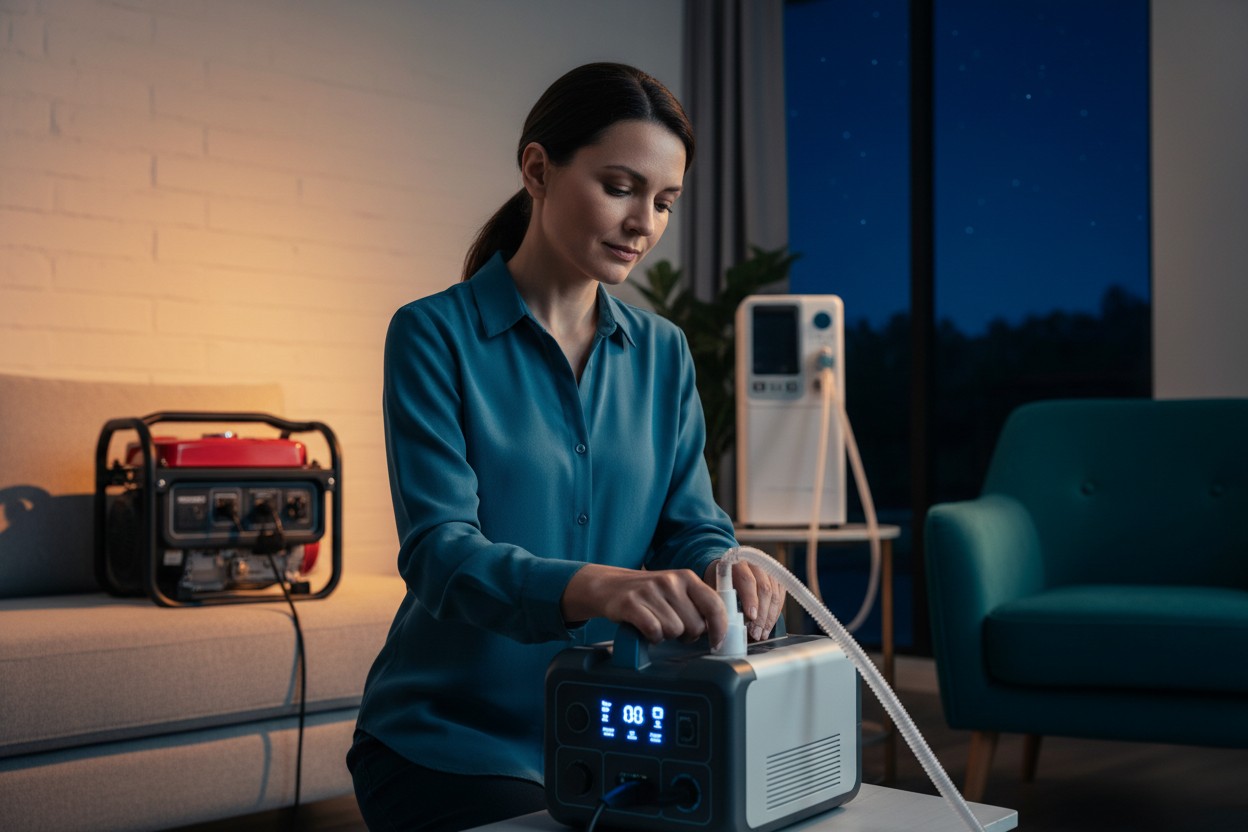
Power outages lasting beyond 72 hours create operational risks for households that depend on electrically powered medical devices such as CPAP machines, oxygen concentrators, and feeding pumps, according to a preparedness guide published on The Survival Mom website.
Author Lisa Bedford discussed extended disruption planning, and she stated that an outage lasting more than three days presents a distinct problem for families with members requiring medical equipment to sleep, breathe, or eat.
Before disaster strikes, families must inventory the power draw of each device and build layered backup systems, including batteries, power stations, and generators, to maintain continuous operation. Bedford emphasized that planning should begin with consultation with medical providers and equipment suppliers before an outage occurs.
The guide also recommends registration with utility companies for critical-care programs, noting that while such registration may improve notification, it does not guarantee power restoration priority.
Calculating Power Requirements
When preparing for emergencies, create a list of each medical device's running watts, hours of daily use, internal battery backup, and DC capability. Running watts listed on a label, or amps multiplied by 120, should be multiplied by the hours of daily use to determine a device's total watt-hours per day, which is a critical figure for selecting backup power systems. Typical power draws range from 30-60 watts for a CPAP (continuous positive airway pressure) machine without heat to 300-600 watts for home oxygen concentrators, with continuous operation of the latter reaching 7,000-14,000 watt-hours daily. Watt-hours per day determine whether a portable power station is sufficient or if a generator is necessary. For a comparative example, a CPAP using 55 watts for eight hours requires roughly 440 watt-hours per night, whereas a home oxygen concentrator at 350 watts running all day uses about 8,400 watt-hours in 24 hours.Backup Power by Timeframe
Follow a staged approach for managing power needs over different durations. For the first minutes of an outage, it's recommended to get an uninterruptible power supply (UPS) with pure sine wave output to prevent sensitive equipment from rebooting when the grid drops. Keep in mind that a UPS is a short-term bridge rather than a multi-day solution. For the first night or two, portable power stations with pure sine wave outlets can cover many lower-draw devices, including CPAP or BiPAP machines, nebulizers, and feeding pumps. Be cautious since these units will not sustain a home oxygen concentrator overnight. For day three and beyond, high-draw equipment requires generators or large expandable battery systems, with power stations serving only as a bridge to buy time until a generator starts or a cylinder is swapped in. Also consider non-electric fallbacks, including extra oxygen cylinders and coolers for medication, and decide on a stay-or-go trigger based on remaining battery and cylinder time.Generators, Fuel, and Maintenance
You can also invest in inverter generators for medical loads due to their clean power output, such as models from Honda, Yamaha, and Champion. Keep in mind that conventional generators may produce distorted power that can make devices noisy, trigger error codes, or shorten battery life, and that backup power sources should list pure sine wave output. Fuel storage estimates include 15-25 gallons of gasoline for three days of moderate generator use, or multiple propane cylinders, which can be stored for extended periods, for dual-fuel models. A mid-size generator may burn 4 to 8 gallons of gasoline daily when run in blocks. For whole-home solutions, it cites standby generators from Generac, Kohler, and Cummins, which operate automatically but require professional installation and lead time. Home battery systems, such as Tesla Powerwall, require a method of recharging via solar panels or a generator for outages lasting more than a day or two.Emergency Registration and Medical Coordination
Register with utility critical-care programs and notify fire departments on non-emergency lines and keep supplier 24-hour numbers accessible. Note that utility designation does not guarantee power priority or faster restoration, and your household should plan on being self-sufficient for the first three days of an outage. If there is a patient in the family, ask their clinician about acceptable operational alternatives, such as turning off CPAP humidifiers to conserve power, and to document evacuation plans for life-support equipment. FEMA reimbursement for generators is possible only after declared disasters and with proper documentation, but the guide recommends against relying on potential reimbursement for purchase decisions. Extended power outages present distinct challenges for households dependent on medical equipment, but advance preparation can mitigate the risks. Listing equipment, calculating power requirements, and establishing a backup power plan are manageable tasks that do not require significant time. Planning for disruptions supports self-reliance when grid power is unavailable. A layered approach, combining battery systems, generators, and non-electric alternatives, enables your family to maintain a continuity of care during extended outages.References
- "No power No Problem: How portable power stations can keep you running after SHTF". NaturalNews.com. June 25, 2025.
- "Survival essentials: How to prepare for medical equipment dependencies when SHTF". NaturalNews.com. November 17, 2020.
- Scott Hunt. "The Practical Preppers Complete Guide to Disaster Preparedness".
- Robert Bryce. "A Question of Power Electricity and the Wealth of Nations".
- "Report Identifies Seven Common Gaps in Family Emergency Plans". NaturalNews.com. September 1, 2026.
- "Best EcoFlow Power Station for Home Backup in 2026". Robotics and Automation News. May 20, 2026.
- TheSurvivalMom.com. "Power Outages and Home Medical Equipment: A Plan for More Than 72 Hours". August 31, 2026.
Mastodon
Parler
Gab
Copy
Tagged Under:
collapse power grid prepping disaster survival self-reliance first aid emergency supplies SHTF prepper tips power Medical Equipment electricity Power Outage alternative power sources backup power energy supply grid instability peparedness emergency preparedess
You Might Also Like

Research Outlines Methods for Recovering From Technology-Related Stress
By Coco Somers // Share
Deadly wildfires force mass evacuations in Türkiye’s Antalya Province
By Cassie B. // Share

Trump’s Oil Holdings Gain Millions Amid Iran War As Accounts Continue Trading
By Garrison Vance // Share
Maryland’s green energy mandates are driving a 50.9% spike in electric bills
By Cassie B. // Share

Trump Predicts Nosedive on Oil and Gas Prices “Right After” Midterm Elections
By Garrison Vance // Share
China’s Coal-Based Electricity Expansion Contrasts with U.S. Reliability Concerns
By Douglas Harrington // Share
Recent News





Popular This Week