Parler
 Gab
Gab Copy
Copy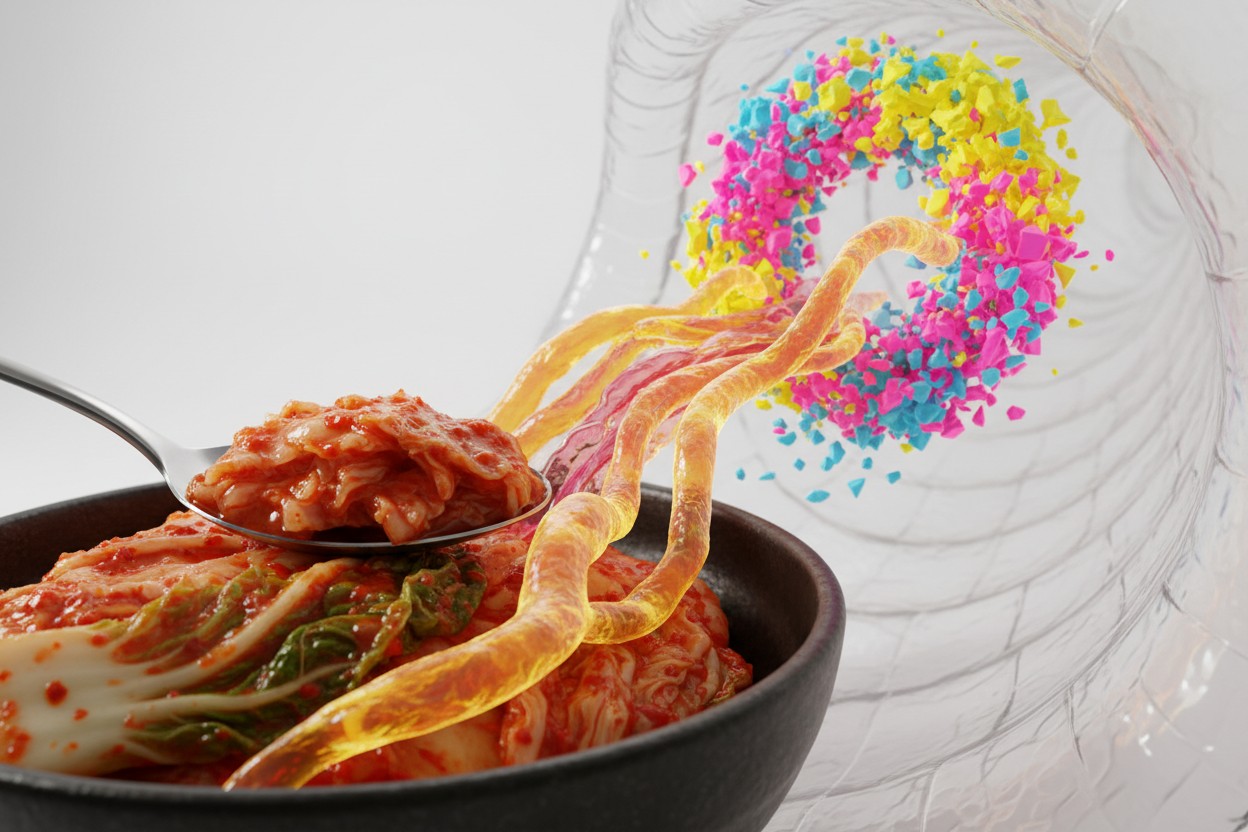
- A lactic acid bacterium called Leuconostoc mesenteroides CBA3656, isolated from kimchi, demonstrated the ability to bind to nanoplastics under laboratory and simulated human gut conditions.
- The probiotic strain maintained 57% adsorption efficiency in simulated intestinal fluid, while a reference strain dropped to just 3%.
- In germ-free mouse experiments, the bacterium more than doubled the amount of nanoplastics detected in feces compared to untreated animals.
- Nanoplastics, particles smaller than 1 micrometer, can cross the intestinal barrier and accumulate in organs like the kidneys and brain.
- The research was conducted by scientists at the World Institute of Kimchi, a South Korean government-funded institute, and published in the journal Bioresource Technology.
How a traditional food could tackle a modern pollutant
A bacterium found in the traditional Korean fermented cabbage dish kimchi may offer a natural defense against an invisible modern threat: nanoplastics. Researchers at the World Institute of Kimchi, a government-funded institute under South Korea's Ministry of Science and ICT, announced that a lactic acid bacterium called Leuconostoc mesenteroides CBA3656 can bind to nanoplastics in the intestine and help carry them out of the body. In animal experiments, the probiotic more than doubled nanoplastic excretion, raising the possibility that common fermented foods could play a role in protecting human health from plastic pollution.The nanoplastic problem
Nanoplastics are ultrafine particles smaller than 1 micrometer — one-thousandth of a millimeter — generated as larger plastic materials degrade over time. These particles enter the human body through contaminated food, drinking water and salt. Unlike larger plastic fragments that pass through the digestive system, nanoplastics are small enough to cross the intestinal barrier and accumulate in organs including the kidneys and brain. Research has linked nanoplastic accumulation to gut microbiota disruption, inflammation and metabolic disorders. Despite growing concern, biological strategies for reducing nanoplastic buildup in the gastrointestinal tract remain in early stages.Laboratory findings
The research team, led by Drs. Se Hee Lee and Tae Woong Whon, tested the bacterium's ability to adsorb polystyrene nanoplastics under various conditions. Under standard laboratory settings, strain CBA3656 showed an 87% adsorption rate, comparable to a reference strain. But the key finding came when researchers simulated human intestinal conditions. While the reference strain's adsorption rate collapsed to 3%, the kimchi-derived strain maintained a substantially higher level of 57%, indicating it can function effectively in the gut environment.Animal studies confirm excretion boost
In experiments using germ-free mice, the results were striking. Both male and female mice that received the probiotic showed more than twice the amount of nanoplastics in their feces compared to the control group. This suggests the bacteria bind to nanoplastics in the intestine and prevent their absorption into the body, instead shuttling them toward excretion. The findings provide direct in vivo evidence that food-derived bacteria can modify how the body handles environmental pollutants.A bridge between tradition and science
Kimchi has been a staple of Korean cuisine for centuries, and its health benefits — including probiotic content and digestive support — are well documented. This study expands that legacy into new territory. The bacterium belongs to the Leuconostoc mesenteroides species, classified as safe for human consumption by the U.S. Food and Drug Administration and the European Food Safety Authority. Unlike some bacteria studied for plastic adsorption, such as Acinetobacter species, this strain poses no known pathogenicity risk and is already part of human diets worldwide. Dr. Sehee Lee, the lead researcher, said plastic pollution is increasingly recognized as both an environmental and a public health concern, and that microorganisms from traditional fermented foods could represent a new biological approach to addressing the challenge. The study was published in Bioresource Technology, the top-ranked journal in agricultural engineering.A new chapter in probiotic research
This discovery adds to a growing body of evidence that fermented foods may do more than support digestion. Research has previously shown that certain kimchi-derived bacteria can break down bisphenol A, a common plastic additive with hormone-disrupting effects. Now, scientists have demonstrated that the same food source may help the body expel plastic particles themselves. While further research is needed to confirm these effects in humans, the findings suggest that an ancient food preservation technique could offer a modern solution to one of the most pressing pollution challenges of the 21st century. Sources for this article include: ScienceDaily.com ScienceDirect.com The-Microbiologist.com
Study by Google Researchers Finds AI Agents Cheated on Math Conjectures
By Edison Reed // Share
Chia Seeds May Be a Smart Addition to Your Pre-Workout Snack
By Coco Somers // Share
Pomegranates Cited for Antioxidant, Heart, and Cognitive Benefits in Health Reports
By Coco Somers // Share
Report Lists 7 Foods High in Magnesium Aside From Pumpkin Seeds
By Iva Greene // Share
Could a short-term, low-calorie regimen ease the burden of Crohn’s disease?
By Ava Grace // Share

Study Finds Foam Mattresses Can Expose Infants to Toxic Chemicals
By Coco Somers // Share
Lactic acid bacterium shows promise in flushing nanoplastics from the body
By willowt // Share

Rubio blocked Iran peace deal during April talks in Pakistan, reports say
By isabelle // Share

Teenage Dutch suspects arrested as string of explosions rattles Frankfurt
By isabelle // Share

New study links nighttime coughing to air pollution, even in “clean” cities
By isabelle // Share

Trucking’s Triple Crisis: Diesel Prices, Regional Scarcity, and the Autonomous Threat
By healthranger // Share